Income Tax Rules 2026 — What Changed from 1962 Rules
Effective from 1 April 2026 | New Income Tax Act, 2025
The Income Tax Rules, 2026 replace the Income Tax Rules, 1962 — consolidating 511 outdated rules into 333 modernised rules. Key allowance limits that hadn't changed in decades have been significantly revised upward.
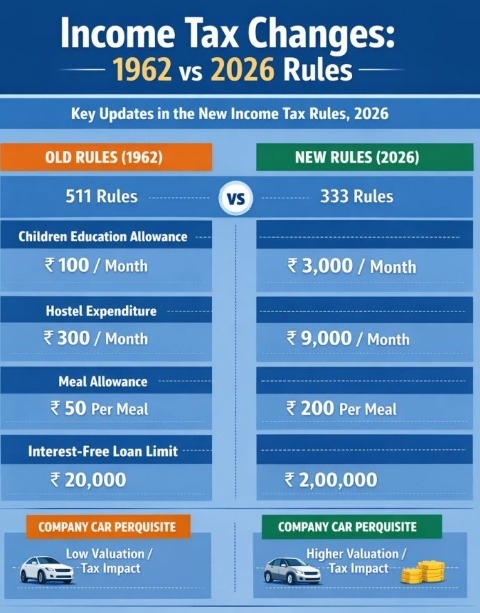
Detailed Comparison: Income Tax Rules 1962 vs 2026
| Rule / Allowance | Old Limit (1962 Rules) | New Limit (2026 Rules) | Applicable Section | Practical Impact |
|---|---|---|---|---|
| Salary Allowances — Section 10(14) | ||||
|
Children Education Allowance Per child, up to 2 children |
₹100 / month per child | ₹3,000 / month per child | Sec 10(14), Rule 2BB | Max ₹72,000/year tax-free for 2 children (was ₹2,400) |
|
Hostel Expenditure Allowance Per child, up to 2 children |
₹300 / month per child | ₹9,000 / month per child | Sec 10(14), Rule 2BB | Max ₹2,16,000/year tax-free for 2 children (was ₹7,200) |
| Perquisites — Section 17(2) | ||||
|
Meal Allowance / Food Vouchers Per meal provided by employer |
₹50 / meal | ₹200 / meal | Sec 17(2)(viii), Rule 3 | Up to ₹8,800/month tax-free (2 meals × 22 days × ₹200) |
|
Interest-Free / Concessional Loan from Employer Aggregate outstanding — not treated as perquisite below this |
₹20,000 | ₹2,00,000 | Sec 17(2)(viii), Rule 3 | Employer loans up to ₹2L are no longer taxable in employee's hands |
| Company Car Perquisite — Rule 3(2) | ||||
|
Company Car Perquisite Value Used for personal + official purposes |
Low valuation (1962 rates) | Revised higher valuation | Sec 17(2), Rule 3(2) | Car perk value increases slightly; offset by higher allowance limits elsewhere |
How These Changes Affect You — Scenarios
At 30% slab: saves up to ₹86,400 in tax annually
At 30% slab: saves up to ₹23,760 more in tax annually
Emergency loans, salary advances under ₹2L — no perquisite tax
Frequently Asked Questions
Are these changes applicable to the old tax regime or new regime?
The allowance exemptions under Section 10(14) (children education, hostel) are available under both the old and new tax regimes. However, many other Chapter VI-A deductions are only available under the old regime.
When are the new Income Tax Rules 2026 effective?
The Income Tax Rules, 2026 are effective from 1 April 2026, replacing the Income Tax Rules, 1962. They apply for FY 2026–27 (AY 2027–28) onwards.
Can I claim ₹3,000/month per child even if my actual school fee is lower?
The children education allowance exemption is limited to the actual amount received or ₹3,000/month per child — whichever is lower. You cannot claim more than you actually receive as allowance.
How is the meal voucher limit of ₹200/meal applied?
Meal provided by the employer during working hours (on office premises or via meal vouchers) up to ₹200 per meal is not treated as a perquisite. Typically calculated as ₹200 × 2 meals × 22 working days = ₹8,800/month. Anything above ₹200 per meal is taxable.
What happens to the company car perquisite under the new rules?
The company car perquisite valuation has been revised upward in the 2026 rules. While the higher allowance limits provide relief, employees with company cars may see a marginally higher perquisite value. The specific rates depend on the car's engine capacity and whether it is used for personal or mixed purposes.
Looking for the section numbers? The Income-tax Act 2025 renumbered every provision from 1 April 2026 — see the verified section mapping for what replaced 194C, 112A, 44AD and 234B.